Category: Industry Trends

Get insights into the forces shaping foodservice and retail. We analyze consumer behavior shifts, labor market changes, and emerging business models to help you stay ahead of the curve and make informed decisions.

  • Making Self-Service Accessible to All

    Making Self-Service Accessible to All

    Contributed by Katie Kochelek, Senior Marketing Specialist at Frank Mayer Kiosks and Displays

    For the latest ADA guidelines regarding self-service technology, visit the U.S. Access Board or review the 2010 ADA Standards for Accessible Design.


    According to a 2024 press release from the CDC, more than 70 million adults in the United States have some type of disability, making up nearly 29 percent of the population.  

    That’s not a niche audience. These findings underscore the importance of guaranteeing equal access for a significant portion of people, and the Americans with Disabilities Act (ADA) does just that.

    Enacted in 1990, the ADA is a federal law that prohibits discrimination and removes barriers for individuals with disabilities. Covering areas like employment, transportation, public spaces, and communication, it requires that systems and environments be designed to support full and autonomous participation. 

    As needs evolved alongside advancements in both digital and physical infrastructure, the U.S. Department of Justice adopted more defined parameters to guide compliance. Two decades after the ADA first passed, the 2010 ADA Standards for Accessible Design established the technical specifications needed to meet ADA requirements. And as of May 2024, the US Access Board has proposed a rule recommending new or revised guidelines specifically for self-service machines.

    Though these standards are extensive, they provide brands with the blueprints to build kiosks that serve all users. And while the clearest benefit is enabling individuals with disabilities to interact with self-service independently, there are also additional advantages to offering a more inclusive experience for all users.

    Still, accessibility doesn’t exist in isolation. A perfectly designed enclosure can only go so far if the kiosk software interface isn’t equally intuitive. Meaningful inclusion depends on collaboration between both the hardware and software of the self-service experience.

    Below, we detail why accessibility in both kiosk hardware and software is more than a responsibility, but essential for both companies and kiosk users alike.

    The Legal Cost of “Almost Accessible”

    Filed in 2019, the Vargas and American Council of the Blind v. Quest Diagnostics lawsuit represents one of the first major federal ADA cases focused on accessibility in self-service kiosks used by a private business. Up until that point, most accessibility cases involving technology either dealt with websites and mobile apps or public technologies like ATMs and ticketing machines.

    The case states Quest Diagnostics’ self-service kiosks violated Title III of the ADA by preventing all users from checking in independently at their facilities. Specifically, without auxiliary aids available, the company’s blind or vision-impaired patients would require assistance to utilize the kiosks.

    Not only does the lawsuit highlight the important clarification that help from staff is not equivalent to independent access, but it also emphasizes that “almost accessible,” or kiosks that have some ADA features but not others, can leave a company open to litigation.

    “In the kiosk and self-service technology world, accessibility doesn’t stop at reach height or button size but extends to how we communicate and interact with every type of user,” says Jared Epstein, Account Executive at Frank Mayer – Kiosks and Displays. “The goal is for every person to use your kiosk, both hardware and software, confidently and without needing help.”

    Jeff Hong, Co-Founder of Bite, a leading intelligent kiosk ordering software for QSR, fast casual restaurants, and convenience stores, agrees.

    “The biggest misconception is that ADA compliance is primarily about wheelchair accessibility—ensuring proper height, reach, and clearance,” Hong states. “While those physical standards are essential, they only address one aspect of disability.”

    Of the millions of Americans with a disability, only 2.3 percent of adults use wheelchairs as their primary mobility devices, proving true accessibility goes far beyond physical reach requirements.

    “If there’s no audio output for people who can’t see the screen, the kiosk is completely off-limits to blind users,” Hong says. “If it has video but no captions, deaf customers can’t access it.”

    He continues, “Digital content accessibility—including screen readers, high-contrast displays, audio output with headphone jacks, alternative input methods, and clear navigation—is just as critical as the physical design.”

    Most companies using kiosks have some level of accessibility built in. That could look like compliant height, reachable screens, or appropriate clearance. But stopping there can leave major usability gaps. Full accessibility goes beyond the minimum standards to ensure every customer can independently engage with the technology.

    Offering Every Guest an Accessible Kiosk Experience

    The ramifications of non-compliance aren’t just legal, though. Failing to accommodate users of every ability can be detrimental to a company’s reputation and credibility as well.

    “Doing the bare minimum leaves millions of people unable to interact with the product, whether that be a kiosk, website, or even physical space,” Epstein asserts. “No accessibility in a product’s design sends a message that some customers matter more than others.”

    In the end, ADA compliance is smart business.

    “Accessible kiosks open doors to millions of potential customers with disabilities while improving usability for everyone,” Hong says.

    He points to software accessibility features like clear contrast, intuitive navigation, and multiple input options as examples of creating better experiences for all guests.

    Plus, he adds, building in accessibility from the start is far more cost-effective than having to retrofit kiosks later. 

    Whether it’s the cost of a lawsuit or the erosion of trust from an overlooked demographic, non-accessible and “almost accessible” designs leave a company open to real consequences. The better path is to recognize it as a fundamental part of designing kiosks.

    Accessibility as Intelligent Kiosk Design

    Frequently, people point to avoiding lawsuits and being cognizant of inclusion as main reasons to build accessibility into a kiosk’s design. However, many ADA guidelines promote good “design intelligence,” too, leading to a better experience for users of all abilities.

    While not a specific ADA requirement, tilted screens are commonly used to support both seated and standing users. The function can optimize reach zones for wheelchair users, but can also reduce glare for anyone operating the kiosk.

    Additionally, adjustable-height kiosks provide convenience for many. The screen and other interactive components move within the ADA’s reach range, accommodating seated users, individuals of shorter stature, and those with limited mobility. Beyond compliance, though, adjustable kiosks reflect design intelligence by making interactions convenient for people of all heights.

    Audio output features are another example of good universal design. Along with software support, this hardware is needed for blind and low-vision users to hear spoken prompts or navigation cues through headphones. Yet these same features enhance the experience for a wider audience. In busy or high-traffic environments, having a headphone jack allows users to hear instructions more clearly or offers a discreet way to receive sensitive information without it being displayed on-screen. 

    When building for ADA standards, it’s good to shift the thinking from legal compliance to design intelligence. Accessibility isn’t a limitation when customizing kiosks. In fact, what begins as a requirement for inclusion often becomes a convenience that benefits all users.

    The ADA Connection Between Kiosk Hardware and Software

    Just because a kiosk enclosure follows ADA specifications doesn’t mean it’s ready for public use. True accessibility in self-service isn’t achieved by either hardware or software alone. 

    Bite knows this well. Recognized in the industry for taking a proactive approach to ADA requirements, they offer everything from language options to audio and voice features as part of their software. In addition, they’re always evaluating new features and opportunities to make kiosks more accessible for everyone, demonstrating a commitment to accessibility beyond just physical compliance.

    When considering a kiosk that meets all ADA standards, both hardware and software must come together to offer a complete package. After all, knee clearance, mounting height, and reach ranges mean little if the software interface is unusable.

    “When hardware and software aren’t in sync, users notice,” Epstein stresses. “But when they are, you end up with technology that’s intuitive for everyone, building loyalty and credibility for your brand.”

    Kiosk Software Accessibility Standards

    Accessibility regulations evolve every few years. A major Access Board rule update came in 2017 with the Revised 508 Standards for Information and Communication Technology (ICT), aligning federal requirements with international standards. WCAG 2.0 (Web Content Accessibility Guidelines) served as the technical benchmark, and today, software follows the extended WCAG 2.1 guidelines published in 2018.

    With constant change, it’s important to think ahead when planning for ADA.

    Hong explains, “Successful kiosk software providers design accessibility in from the start and maintain ongoing compliance as standards evolve, rather than retrofitting features after regulations change. While not all WCAG standards are applicable on a kiosk environment, Bite strives to meet AA compliance for all relevant guidelines.”

    So, what are industry-standard ADA features typically included in kiosk software? 

    • High-contrast displays with adjustable font sizes
    • Audio output with headphone jacks and volume control
    • Speech output for all on-screen information
    • Keyboard navigation and alternative input methods
    • Tactile feedback options
    • Visual cues accompanying audio prompts

    Bite also integrates screen readers for visually impaired users, language options for diverse populations, height-adjustable kiosk interfaces, and compatibility with assistive hardware technologies.

    The Future of Kiosk ADA Standards

    Currently, the U.S. Access Board designates kiosks alongside ATMS and fare machines, but no final rule explicitly covers self-service kiosks, causing the category to fall into a kind of regulatory gap.

    On Sept. 21, 2022, the Access Board published an Advance Notice of Proposed Rulemaking (ANPRM) to develop supplemental accessibility guidelines for self-service transaction machines (SSTM), including self-service kiosks. In short, the rulemaking process for kiosks is still in its early stage, when the government collects public input from individuals, advocacy groups, and other agencies.

    Once feedback is reviewed, the next step will be a formal draft of the rule, followed by a final version that will carry legal weight. For now, it’s a clear sign that federal standards are on the horizon.

    Better defined rules for accessible kiosk hardware are only part of the picture, though. Kiosk software will increasingly define what accessibility looks like in the years ahead.

    When asked where the biggest opportunities for innovation in ADA-compliant software lie in the upcoming years, Bite lists everything from AI-powered personalization and enhanced sensory technologies to advanced voice and gesture recognition as being in the realm of possibility.

    As hardware guidelines become clearer and software capabilities expand, the goal remains the same: to create kiosks that enable every user to interact independently and confidently.

    Hong sums it up best. “The future is moving away from ‘ADA as a checkbox’ toward truly universal design where accessibility creates better experiences for everyone.”

  • The QSR Survival Playbook: 7 Game-Changing Strategies to Win in Today’s Market

    The QSR Survival Playbook: 7 Game-Changing Strategies to Win in Today’s Market

    The QSR industry is at a breaking point. With only 14% of consumers still viewing fast food as budget-friendly and labor shortages forcing 48% of operators to reduce hours, the traditional QSR playbook is quickly becoming obsolete. But here’s what the hardliners miss: the brands that adapt now will dominate the next decade.

    This isn’t about tweaking your value menu or running another BOGO promotion. It’s about fundamental transformation. The winners this year and beyond will be those who embrace radical efficiency through automation and technology, create irresistible customer experiences through data, and build operational models that thrive despite economic headwinds.

    1. Deploy Kiosks as Revenue-Generating Machines

    Kiosks aren’t just a labor-saving tool. The data reveals that kiosk orders generate up to 30% higher average tickets than counter orders.

    The math is compelling: Research shows that 63% of operators saw higher check sizes specifically attributed to upsell prompts built into self-ordering kiosk software.

    The Kiosk Profit Formula:

    • Position kiosks prominently near entrances and high-traffic pathways to capture greater adoption
    • Partner with companies like Bite, which design intuitive and user-friendly interfaces that naturally guide customers toward premium options
    • Implement upselling prompts that highlight add-ons and upgrades, leveraging visual menus that make premium items stand out
    • Use data from kiosk orders to identify your most effective upsell combinations and optimize menus based on popular items
    • Integrate kiosks with loyalty programs and mobile apps for seamless omnichannel experiences

    Don’t make the mistake of viewing kiosks as standalone devices. The biggest ROI comes from higher average checks, personalized upsells, loyalty tie-ins, and more efficient order flow.

    2. Turn Ghost Kitchens Into Your Expansion Engine

    While competitors struggle with real estate costs, other operators are scaling through ghost kitchens, which offer a big cost advantage. Startup costs range from just $30,000 to $100,000, compared to hundreds of thousands or even millions for traditional restaurants. CloudKitchens, for example, enables establishments to start cooking in as few as 8 weeks with as little as $30,000 initial investment.

    Your Ghost Kitchen Game Plan:

    • Test new concepts without the risk of full buildouts
    • Use ghost kitchens as staging areas for new locations, speeding up construction
    • Operate multiple virtual brands from the same kitchen space
    • Focus solely on delivery without front-end investments in dine-in facilities, benefiting from smaller footprints, lower rentals, and improved efficiency through shared resources
    • Partner with established platforms that handle logistics, cleaning, and maintenance

    The most sophisticated operators are running hybrid models—maintaining their flagship locations while using ghost kitchens to penetrate new markets and test menu innovations with minimal risk.

    3. Make AI Voice Ordering Your 24/7 Sales Machine

    Labor shortages aren’t temporary. The restaurant industry has 1.4 million job openings with turnover approaching 75%. One solution lies in AI voice ordering that’s always clocked in.

    Drive-thrus account for as much as 70% of sales at many brands, making even incremental improvements financially significant. Early adopters are seeing game-changing results: For example, Vox AI’s deployments demonstrate ROI increases of up to 17 times, with shorter drive-thru queues, enhanced upselling, and higher customer satisfaction.

    Voice AI Implementation Strategy:

    • Deploy systems that handle orders 24/7 in multiple languages
    • Focus on truly autonomous AI that requires no human intervention during operation
    • Implement systems that make more context-specific upsell attempts than human employees
    • Ensure seamless integration with existing POS and kitchen systems
    • Use AI for both drive-thru and phone ordering (if available) to maximize coverage

    The technology is mature and scaling rapidly. Companies like ConverseNow, Kea, and SoundHound AI are all competing for market share, driving innovation and reducing costs.

    4. Leverage Data for Hyper-Personalization

    Generic marketing is dead. Brands running 200 experiments monthly gain insights that would take traditional marketers years to uncover, with successful personalization delivering 20-30% improvements in conversion.

    The opportunity is massive: QSRs using AI-powered predictive analytics for personalized marketing see double-digit lifts in click-through rates and average ticket increases that flow directly to the bottom line.

    Your Data Domination Playbook:

    • Centralize data from POS systems, mobile apps, and delivery platforms into a unified platform for complete customer visibility
    • Use predictive analytics to anticipate demand and optimize inventory
    • Test creative variations at scale—one QSR evaluated 320 variations in 18 days, achieving a 22% increase in customer acquisition at 31% lower cost
    • Create location-specific profiles to understand local preferences and behaviors
    • Leverage AI to deliver personalized offers that drive higher open rates and millions in incremental revenue

    Remember: Those who are nailing personalization are growing 40% faster than their counterparts

    5. Automate Everything That Doesn’t Require a Smile

    Beyond front-of-house automation, the real efficiency gains come from comprehensive back-of-house transformation. The global robot kitchen market is projected to reach $9.6 billion by 2033, growing from $2.7 billion in 2023.

    Automation Priority List:

    • Online ordering systems that integrate directly with POS and kitchen displays, eliminating manual order entry
    • Robotic kitchen systems for grilling, frying, and plating
    • AI-powered workforce optimization that balances employee availability with demand, reducing labor costs while improving efficiency
    • Automated inventory management with predictive ordering
    • Labor management software that handles scheduling, time tracking, recruiting, and payroll

    The key is strategic implementation. Start with your most time-consuming, repetitive tasks to see immediate efficiency gains, then expand systematically.

    6. Rethink Your Menu as a Profit Engine

    With nearly 1 in 4 consumers now viewing fast food as a “treat” or “reward”, your menu strategy must evolve beyond basic value plays.

    The Profit-Maximizing Menu Framework:

    • Create a barbell strategy: rock-bottom value items paired with premium, high-margin options
    • Add unique twists to familiar favorites. For example, when chains introduce premium items like wagyu or truffle fries, 30% of consumers express excitement, jumping to 42% among parents
    • Use data to identify and eliminate low-performing items
    • During labor shortages, analyze menu items to identify the most popular dishes and purge slow-moving ones, particularly those requiring multiple cooking steps
    • Design limited-time offers that create urgency without cannibalizing core items

    Your menu should tell a story that resonates with both value-seekers and experience-chasers. 

    7. Build Loyalty Programs That Drive Behavior

    Traditional points-based programs are table stakes. Modern loyalty requires sophistication. 80% of QSR operators say traditional loyalty isn’t working for their brand.

    Next-Generation Loyalty Tactics:

    • Use personalized offers based on purchasing history and real-time behavior
    • Implement subscription models for frequent customers (unlimited drinks, meal bundles)
    • Integrate gamification and real-time rewards to keep customers engaged
    • Create exclusive experiences and early access to new items for top-tier members
    • Use integrated platforms that combine loyalty with ordering data to optimize staffing and maintain service standards

    The best programs create emotional connections beyond transactions. Think community, not just coupons.

    The Bottom Line

    The QSR industry is undergoing its most significant transformation since the invention of the drive-thru. Economic pressures, labor challenges, and evolving consumer expectations are forcing a complete reimagining of the business model.

    But within this disruption lies unprecedented opportunity. Brands willing to embrace automation & technology, personalization, and new operational models aren’t just surviving—they’re positioning themselves to capture market share from their competitors.

    The question isn’t whether to transform, but how quickly you can execute. Every day you delay is a day your competitors pull further ahead. The playbook is clear, the technology is proven, and the market rewards for early movers are substantial. 

  • Welcome to Reservation Wars 3.0

    Welcome to Reservation Wars 3.0

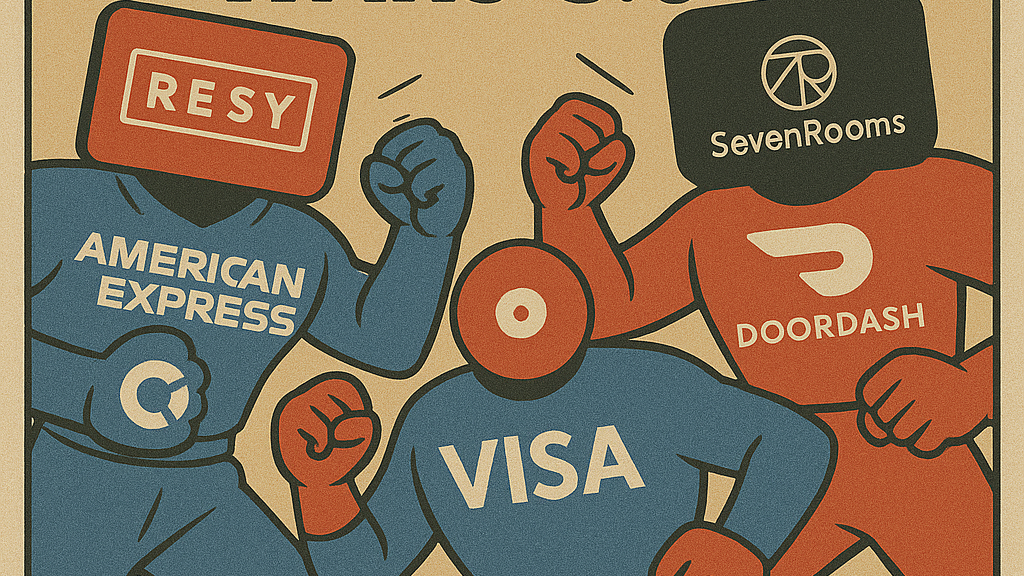
    Get your popcorn out, Reservation Wars 3.0 is here. And on this go-around, nearly the whole restaurant tech ecosystem is involved. Below is an attempt to break it down and perhaps even make a few predictions of what happens next.

    First up, let’s draw some lines in the sand. It’s easy to establish the primary foes: it’s Resy & Tock vs OpenTable vs SevenRooms. But the fun begins with all the partners, big and small, they’re bringing to the fight.

    Each reservation platform has a credit card partner with varying depths of relationship. Let’s go into each:

    Resy & Tock Are Owned by American Express

    One would think this is straightforward, and it kinda is — yet mosey over to the Chase Ultimate Rewards website and you’ll find Tock powering its Dining Experiences. I predict that we have just a few months, or even weeks, left to see those two partnered.  Amex closed on its Tock deal in mid-October 2024, so we’re coming up on the one-year mark, and I’d bet that OpenTable has been chomping at the bit to take over offering, say,  Sapphire cardholders’ reservations to Estela (which I went to recently and deserves no more than a walk-in bar visit for steak tartare and ricotta dumplings).

    Tock powering Chase Ultimate rewards.
    Tock powering Chase Ultimate rewards.

    OpenTable is Deeply Partnered with Visa & Chase

    What’s the counterbalance to Amex buying Resy? Visa and OT, obviously. Smart move by OpenTable to bring on a deep-pocketed credit card partner who has no love for Amex. In July 2024, OT launched the Visa Dining Collection, similar to Resy’s Global Dining Access, where cardholders can book tough-to-get reservations. Behind the scenes, Visa can help to support marketing dollars for OpenTable restaurants, often in exchange for some level of exclusivity to the OT/Visa alliance. While I have no interest in “who shot first”, Amex has a similar program using lump sums to keep Resy/Tock restaurants on their side (obscure ‘90s reference in honor of Jimmy Frischling and Han did). BTW, my pod with Kristen Hawley, called The Simmer, was a main character in the “paying restaurants for their reservations loyalty” accusations in 2024.

    Not to complicate things (too late), but OT also has a partnership with Chase, billed as the Sapphire Reserve Exclusive Tables, launched April 2025. Again, “Exclusive Tables” at hot restaurants, yadda yadda yadda.

    SevenRooms Powers Capital One Dining

    The entire Capital One Dining program is built on top of SevenRooms, a playbook that SevenRooms had with Amex and their concierge service before Resy stepped in. So far, it’s unclear how DoorDash’s buying of SevenRooms will affect this partnership, as DD has a tight relationship with Chase/Mastercard, offering DashPass memberships for free to eligible cards since 2020 (and announced in Aug 2024 that this will extend to 2027).

    It will take a while, but I predict that Capital One gets squeezed out of the new SevenRooms / DoorDash partnership, just by virtue of being the C player in the credit card game. For now, showing that you have no reservations at 4 Charles Prime Rib for the foreseeable future, I guess, is cool!?! Also, at a much smaller scale, Capital One has, um, “assembled” (read: paid for) its own Signature Collection of restaurants. 

    Just another way to get rejected by 4 Charles.

    So, to cover step one… it’s now:

    Resy & Tock & Amex vs. OpenTable & Visa & Chase vs. SevenRooms & Capital One.

    Let’s bring in the ordering platforms! And since there is no bigger player than DoorDash, we should start with them.

    DoorDash Owns SevenRooms

    DD closed on its acquisition of SevenRooms in July 2025. It only took a few months to get reservations live in the DoorDash app via the new “Going Out” feature. I hear DoorDash is out collecting its best-of-the-best restaurants and offering compensation for it. Same playbook, different benefactor.

    It’s a given they will get some big-name restaurants away from OT/Resy/Tock. DoorDash can and will bundle its third-party delivery fees or Drive fees with its first-party products (ordering, reservations, pos, etc) to grow its footprint within any restaurant. For the QSR world (where I hear DoorDash is making huge inroads fast), the bundle is with first-party web ordering. For full service, the bundle will include some grip on the reservation book. The only question that remains is how much table inventory  DD can force a restaurant to hold. My guess is they’ll come out with near 100% and when restaurants see cover declines, they’ll become less strict. Changing consumer behavior is hard, and the average DD user isn’t yet accustomed to opening the app when making reservations.

    OpenTable and Uber Partner

    A week after the DoorDash acquisition of SevenRooms was announced, OT and Uber provided some details on their previously announced partnership. Not a coincidence. Kristen’s Expedite covered this perfectly here. At some future point, you’ll be able to book hot reservations in the Uber app and even use your OT points for an Uber. It’s not a stretch to see Uber doing what it takes to get the best restaurants in its app. Which means bags of money showing up at 275 Mulberry St. to pull them off Resy. People have been chattering about how Booking Holdings might/should spin out OT — would Uber be a buyer?

    Resy & Tock & Toast

    So when the music stopped, the Amex reservation arm was left without a delivery dance partner. There is, of course, Grubhub / Wonder / Seamless – but that’s not really a choice. Instead of taking on that baggage, Amex, somewhat predictably, went to the dominant full-service POS in the US, Toast. During the pandemic, and somewhat thereafter, Toast has leaned into more B2C opportunities with products like Local by Toast, a consumer app where one can order pickup or delivery. In the future, users of the Local App will see Resy and Tock reservations available. I can’t help but think this isn’t going to have a huge impact on restaurants. The reservations functionality in the Local app is buried (it gets the same treatment as “gift cards”), and I’m certain the user base is way smaller than all the other options.

    So what’s the play here? Their press release leads with “personalized hospitality experiences,” which translates to the service team knowing more about your previous dining history to better serve you on this visit. In theory, beautiful. In practice, really hard to pull off. There is always this data issue with full-service restaurants – it’s hard to figure out which guests are sitting in which seats at a table and thus what they ordered. Reservation data captures one name, and the other people as essentially anonymous. Regardless of its usefulness, the top restaurants will (over)value this path towards greater hospitality.

    Here’s where it gets fun: if the partnership has some exclusivity, whereas Toast won’t open this functionality to other reservation platforms, then it creates a virtuous lock-in for the overlap in their customer bases. If you leave Resy, you lose all that juicy POS data about your guests. Same if you switch POS. Also fun is the MONTH? announcement Toast has added Uber Direct as the default option for restaurants that use Toast’s first-party ordering. This is best viewed as a strategic step away from DoorDash, which is increasingly competing with Toast for first-party ordering and possibly POS. “But wait, aren’t Uber and OT partnered?” Yes. See: fun!

    Superteam Updates:

    Resy & Tock & Amex & Toast vs. OpenTable & Visa & Chase & Uber vs. SevenRooms & Capital One & DoorDash.

    Can we call them T.A.R.T., V.O.U.Ch, and Do.C.S.?

    This is becoming quite the Royal Rumble. And yet there are a few more companies that might be forced into the ring. For the most part, this has all been about the full-service segment of the industry. Yet DoorDash and Uber play a significant role in the QSR and Fast Casual segments, while Toast seems to be increasing its market share. Which leads to some strange bedfellows. Let’s quickly explore a few.

    Where Does Olo Fit In?

    The take-private of Olo from ThomaBravo, followed by the large layoff, are both signs that Olo is going to get active on the biz dev and corp dev fronts. They have up-and-coming competitors in their space (Deliverect, CheckMate, etc) trying to nip at their Rails business while the Toasts and DoorDash’s of the world are attacking their first-party ordering dominance. No one wants to fight a two-front battle. So if Olo gets involved here, I couldn’t see them pairing with TART or DOCS. With the natural alignment of Olo and Uber, VOUCH feels like the right pairing. OpenTable is also best suited for the largest full-service restaurant groups, many in Casual Dining, an industry segment where Olo has deep ties. What would be interesting is to try and make a guest data play here, similar to the Resy-Toast thing, but without involving the POS. Which works here because the goal is less about using data history to service a guest in the moment, as it is about marketing to that guest post-visit or post-order.

    By the way, let’s not forget that Olo bought Omnivore in 2022, which is significant because (a) Omnivore connects many tech companies to the legacy POS stack, and (b) they are partnered with Resy and OpenTable.

    What About The Other POS companies?

    There are a lot of POS players out there – we’ll touch on a few.

    PAR is a huge POS in the enterprise QSR space that now has competitive products in first-party ordering. They would never partner with Toast and are unlikely to partner with DoorDash given their move towards first-party. Yet if Olo starts aligning with VOUCH, I’ll be watching to see what PAR does, as there is always a bit of frenemy friction there.

    NCR, which is more legacy POS and has a stronghold in the casual dining space, has a natural ally with the VOUCH group, as OT is the reservation system of choice for casual dining.

    Micros, a part of Oracle, has a strong hold on the hotel industry, which was a strategic part of SevenRooms’ growth, especially internationally. Toast has made some strong inroads with hotels through a Marriott partnership, so there is little love there. If Oracle, the nearly $800 billion blue chip, decided to get involved, my guess is Larry would text Tony and they’d get a deal done. It’s happened before.

    Elon and Larry texting for a small investment.

    Qu is busy winning QSR and Fast Casual business, so I think they’re on the sidelines here. Spot On should have an opinion here, but they also have their own reservations platform, so they might be handcuffed. Square is making a full-service push, too—yet this is something they told me in 2018 as well. Not sure they’ll get involved in this game, yet. Clover bought the best restaurant website company in history, BentoBox, and is trying to make a play in fine dining (see: Lilia). With Fiserve’s backing and the leadership of Krystle Mobayeni, I’ll speculate that they won’t sit idle.

    What to Watch For

    To sum this all up, we have TART vs. VOUCH vs. DOCS. What I’m watching for is the movement of key restaurants. Which restaurants are on all platforms, and which are exclusive? The Hospitality Godfather himself, Danny Meyer, was already quoted in the DoorDash Going Out press release (likely due to his 2023 investment into SevenRooms via Enlightened Hospitality Investments). Yet there is no way his restaurants will go exclusive to DOCS. This is likely to be a long war. A war of attrition. A virtual rock fight. Every alliance has deep pockets.

    One thing is for sure: it will get harder before it gets easier for both restaurants and consumers. Restaurants already have an overwhelming amount of conflicting marketing channels. And with many of the platforms trying to lock in inventory, they don’t have the flexibility they need to reach all guests on all channels. As for consumers, there is still no clear, easy way to answer “What is the perfect restaurant to make a reservation at tonight?” With 3 different reservation platforms to check availability, the only solution will be to ask your favorite LLM. To me, this leads to a flattening of the market and a dilution of taste. As Kristen puts it: sameness everywhere. While the future holds personalized GPTs and AI dominance, I’m just excited to watch the current competition right in front of us. So sit back, relax, and enjoy the show!