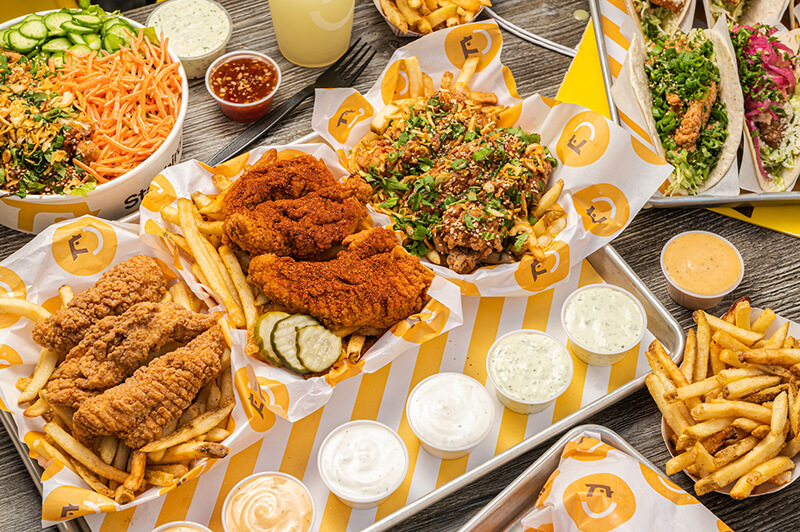
While burger chains grew just 1.4 percent in 2024, chicken-centric QSRs grew nearly 9 percent. Needless to say, the category is booming. The brands pulling ahead aren’t just riding that wave—they’re building operations designed to scale it. And increasingly, that means going all in on kiosks.
Chicken’s Moment Is Here (And It’s Not a Blip)
The numbers tell a clear story. According to Datassential, the limited-service chicken segment is now the fastest-growing major QSR category by unit count, expanding at a 4.4 percent annual rate with sales reaching $55.24 billion in 2025. Chicken now accounts for roughly 12 percent of all U.S. chain restaurant sales, up from 7 percent in 2015—a share gain that would be staggering in almost any other category.
QSR Magazine’s 2026 QSR 50, the industry’s annual benchmark for chain performance, reinforces why. Wingstop posted $4.8 billion in 2024 sales with 20 percent same-store sales growth and 278 net new units. Chick-fil-A added 178 net new units in 2025 alone. These aren’t outliers. They’re indicators of where franchise capital and consumer attention are flowing.
The momentum is holding even as the broader fast-food sector struggles. Placer.ai data shows chicken chains were among only three QSR segments to grow visits in the first half of 2025, even as burger traffic fell 1.7 percent and sandwich concepts dropped more than 3 percent.
Investments follow the consumer data.
- Jollibee, the Filipino fast-food giant, signed three multi-unit franchise agreements in the U.S. in H1 2026 alone and is targeting 500 U.S. locations by 2030.
- Slim Chickens is rolling out 50 new UK locations in 2026 while aggressively expanding through Texas.
- Bonchon, with more than 147 U.S. locations, is pushing into Kansas City, San Antonio, Chicago, and Omaha.
- Big Chicken, the fast casual founded by Shaquille O’Neal, continues to accelerate its national footprint.
All four have heavily invested in kiosks to meet their customers’ preference in ordering.
There’s a more nuanced picture beneath the headline growth, though. Foot traffic per location has declined across the category as brands have raced to open units. What that signals: raw expansion alone doesn’t protect margins. The operators positioning themselves to win long-term are building better unit economics, not just more units. Kiosks are a meaningful lever in how they’re doing it.
Why Chicken Menus Are Built for Kiosk Ordering
Not every restaurant category benefits equally from kiosks. Chicken concepts do.
The reason is menu architecture. Chicken concept menus are customization-heavy by nature: spice levels, sauces, bone-in or boneless, sandwiches or tenders, combo configurations, and seasonal LTOs.
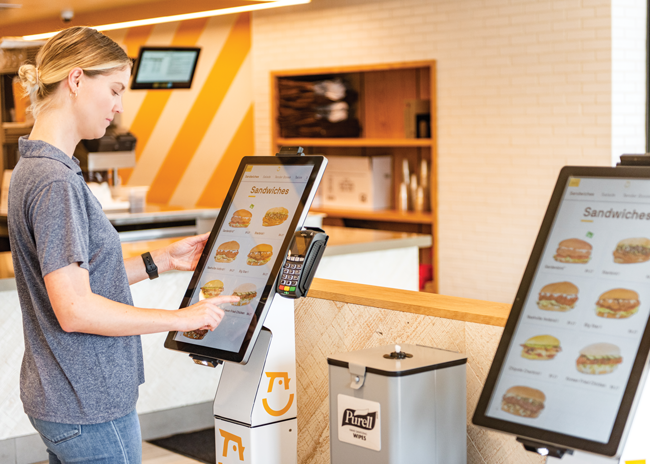
At a front counter, that complexity creates friction. A guest takes longer to decide, the cashier slows to accommodate, and the line backs up. On a kiosk, that same complexity becomes an asset. The guest can browse, explore options, and modify their order at their own pace, all while the visual merchandising does the selling that a counter employee simply can’t replicate under volume.
This matters especially for culturally rich menus. Jollibee and Bonchon bring globally influenced flavor profiles with nuanced modifier options—the kind of menu that benefits enormously from a visual, self-guided ordering experience where guests can learn as they order, not just transact.
There’s a throughput argument, too. Chicken concepts often see compressed, high-volume windows at lunch and dinner. Kiosks absorb order volume independently, reduce the queue, and give kitchens more predictable ticket flow without requiring additional front-of-house labor.
Starbird Built the Playbook
Starbird Chicken is the clearest proof point the industry has for what a kiosk-first chicken concept looks like in practice.
The Silicon Valley-born chicken brand began piloting Bite kiosks in 2019. When COVID hit six months later, they accelerated the rollout—deploying kiosks outside locations as a contactless ordering solution. What started as a response to circumstance became a strategic advantage. Today, Starbird operates three to four Bite kiosks in over a dozen of its locations, and is designing new restaurants with kiosks as the primary ordering method.
The results are measurable. Between 60% and 70% of all in-store orders at Starbird now flow through Bite kiosks. And the platform has become something beyond an ordering tool—it’s their primary guest data acquisition channel.
By integrating Bite kiosks with Attentive’s SMS platform, Starbird grew their subscriber list 6X in just six months. Of their 136,000 total SMS subscribers, more than 108,000 — nearly 80%—opted in via kiosk. Those kiosk-acquired subscribers have become their highest-performing SMS audience.
“Integrating Bite’s kiosk technology with Attentive has been a game-changer for us,” said Casey Hilder, Director of Marketing at Starbird. “It’s allowed us to build a stronger connection with our customers, delivering timely, personalized messages that enhance their experience and keep them engaged with the Starbird brand.”
The Compounding Benefits: Check Size, Loyalty, Speed
The financial case for kiosk ordering in chicken concepts compounds quickly.
Bite Lift, Bite’s AI-powered upsell engine, analyzes each transaction in real time and surfaces contextual recommendations—a sauce upgrade, a larger combo, an add-on that pairs with what’s already in the cart. Across Bite’s customer base, Bite Lift consistently drives a 20 percent or greater increase in average check size. At a chicken brand averaging a $12 to $16 ticket, that lift adds up fast across a multi-unit footprint.
Order accuracy improves as well. Guests entering their own orders—especially complex, multi-modifier ones—eliminate the miscommunication that causes re-fires and comps. In a category where margins are already under pressure from ingredient costs and labor, removing that friction from the kitchen is material.
Then there’s the loyalty flywheel. Starbird’s experience shows that kiosks are an underutilized opt-in channel. Guests who are engaged enough to visit in-store are exactly the audience brands want in their SMS and loyalty programs. The kiosk catches them at the right moment, in the right context.
Building for the Category’s Next Chapter
The chicken QSR segment is still early in its expansion cycle. New units will continue to open, menus will get more complex, and competition for the same guest will intensify. The operators who build smarter infrastructure now will outperform those who try to retrofit it later.
That means designing new locations with kiosks as primary ordering channels. It means using kiosk data to understand what guests actually order, which upsells convert, and which LTOs are working in which markets. And it means treating the kiosk as a guest relationship tool, not just a transaction terminal.
The brands already doing this—Starbird, Bonchon, Slim Chickens, Big Chicken, Jollibee—are some of the fastest-scaling names in the category. That’s not a coincidence.
If you’re building or growing a chicken concept, see what Bite can do for your operation.
Leave a Reply