Longtime restaurant exec and OpenTable advisory board member Chris DeSaye knows the bookings business as well as anyone and has a clear view of what comes next. In this episode, we talk DoorDash, artificial intelligence, and, of course, the always-evolving reservations biz.
Author: Brandon Barton
-

The Simmer Podcast—Rachael Nemeth Co-founder & CEO, Opus Training
Rachael Nemeth runs a technology company, but she thinks like a hospitalitarian. Opus Training is a training operating system designed for multi-unit restaurants, helping empower front-line restaurant workers, including managers. In this episode, we talk about modern restaurant training, AI, and why the human touch is still supreme, even if the bots are helping.
Topic Time Stamps:
1:00: An update on the state of the reservations business: alliances, strategies, money, and more
7:16: Conversational AI comes to the point of sale
9:36: Welcome, Rachael
13:43: What happens when large restaurant groups don’t have good data about their workforce
16:30: How good staff training translates (fast!) to better restaurant operations
20:50: What’s AI’s role, now and in the future?
26:53: What about cameras in restaurants? (The case for and against)
33:51: When computer vision helps employees
36:29: The promise of human interaction at restaurants in an AI-infused world
-
The Simmer Podcast—Elizabeth Tilton, Founder & CEO, Oyster Sunday and OS Benefits
Elizabeth Tilton started her career cooking in New Orleans before moving to join the marketing team at Momofuku in New York City. Years later, she’s translated that back-of-house experience to her own consultancy, Oyster Sunday, which acts as a back office for restaurants across the country. That led to a second company, OS Benefits, which provides ACA-compliant health insurance and wellness benefits to independent hospitality businesses across the country. In this episode, we talk through all the facets of dining out in 2025, and what we’re all excited for in the future.
Topic Time Stamps:
1:27: Here come apps — including OpenTable and DoorDash! — inside ChatGPT
8:00: “That cute little robot” from DoorDash.”
11:53: Welcome, Elizabeth + all about Oyster Sunday and OS Benefits
19:30: As a consultant, what are restaurants worried about? What are you hearing at scale?
26:40: Thoughts on Emeril’s in New Orleans? (Spoiler alert: it’s incredible!)
33:35: How restaurants can find the right balance between tech and hospitality, and who Elizabeth looks to for inspiration.
-
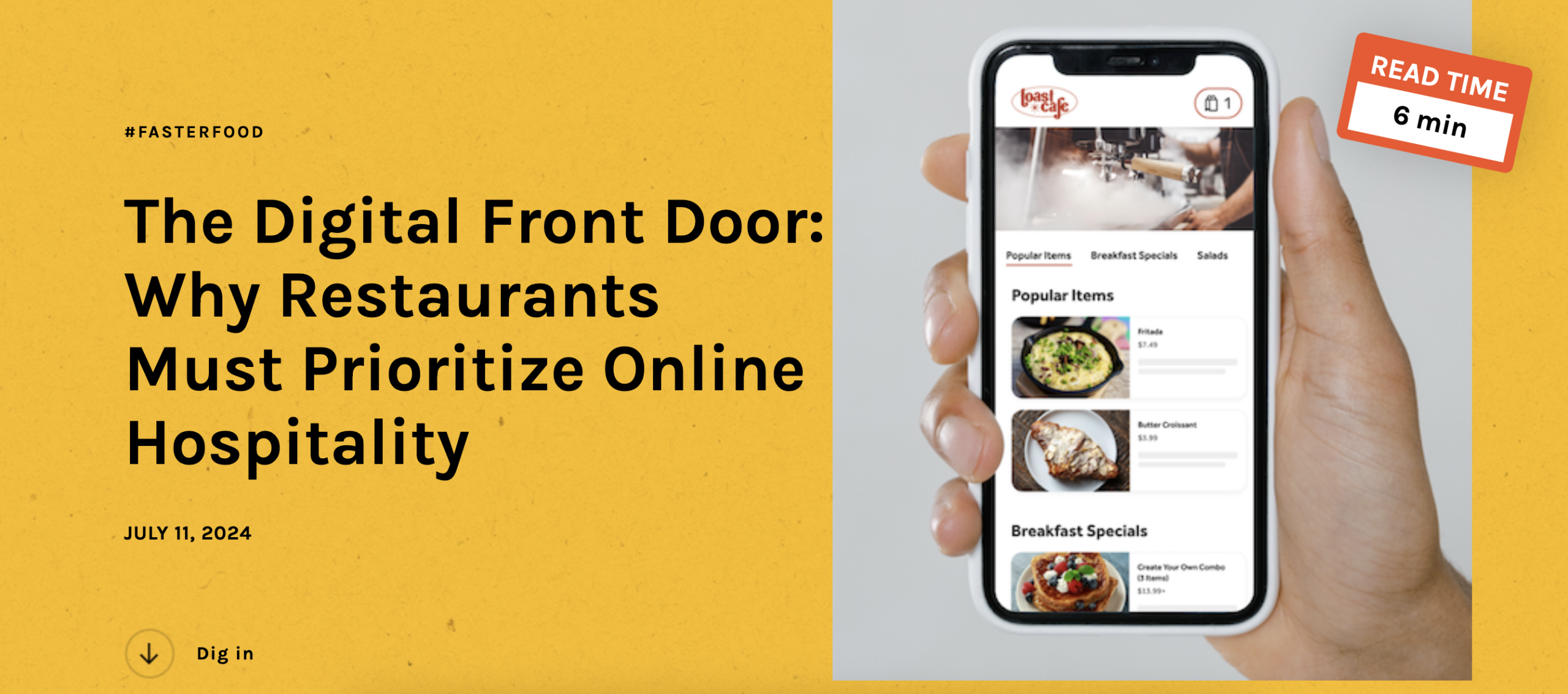
The Digital Front Door: Why Restaurants Must Prioritize Online Hospitality
The following is a guest post from fellow HNGRY Trends member Brandon Barton, CEO of Bite and co-host of The Simmer podcast.
There are no shortage of restaurant tech companies. Despite trends of consolidation, there are more companies pitching ‘just-right solutions’ for the moment each year. The natural reaction to this abundance of choice is to recoil, reject it, and go with the easiest, laziest choice– an all-in-one solution. For some parts of the restaurant stack in certain segments, this works and might even be my recommendation. But in the name of hospitality, can we all agree that our guests deserve better than a cookie-cutter, “engineering side project” ordering experience? Hospitality is holistic. Now, more than ever, guests are evaluating your brand on your digital experience and I’m here to tell you that “all-in-one” stops at the guest experience.
-
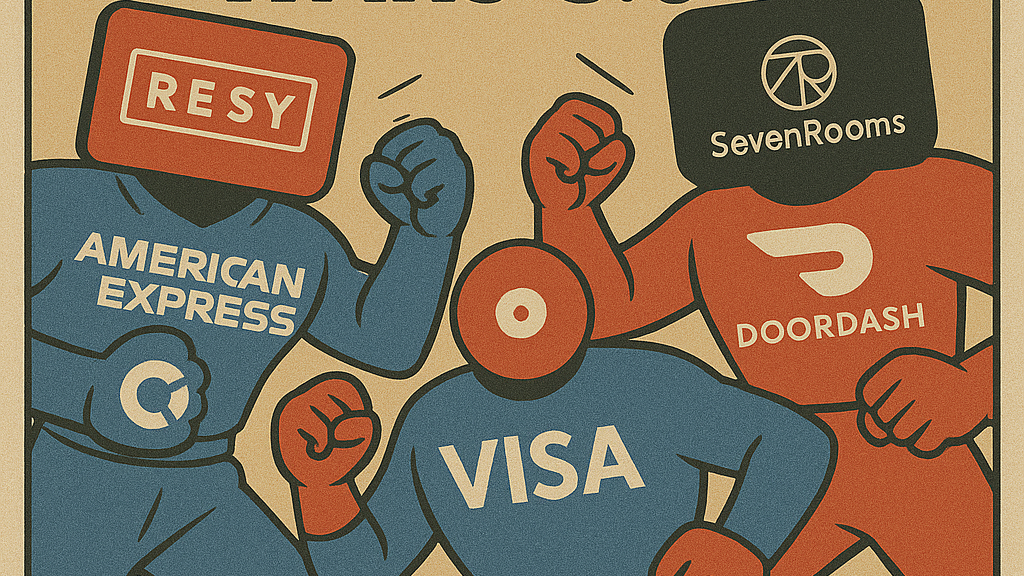
Welcome to Reservation Wars 3.0
Get your popcorn out, Reservation Wars 3.0 is here. And on this go-around, nearly the whole restaurant tech ecosystem is involved. Below is an attempt to break it down and perhaps even make a few predictions of what happens next.
First up, let’s draw some lines in the sand. It’s easy to establish the primary foes: it’s Resy & Tock vs OpenTable vs SevenRooms. But the fun begins with all the partners, big and small, they’re bringing to the fight.
Each reservation platform has a credit card partner with varying depths of relationship. Let’s go into each:
Resy & Tock Are Owned by American Express
One would think this is straightforward, and it kinda is — yet mosey over to the Chase Ultimate Rewards website and you’ll find Tock powering its Dining Experiences. I predict that we have just a few months, or even weeks, left to see those two partnered. Amex closed on its Tock deal in mid-October 2024, so we’re coming up on the one-year mark, and I’d bet that OpenTable has been chomping at the bit to take over offering, say, Sapphire cardholders’ reservations to Estela (which I went to recently and deserves no more than a walk-in bar visit for steak tartare and ricotta dumplings).

Tock powering Chase Ultimate rewards. OpenTable is Deeply Partnered with Visa & Chase
What’s the counterbalance to Amex buying Resy? Visa and OT, obviously. Smart move by OpenTable to bring on a deep-pocketed credit card partner who has no love for Amex. In July 2024, OT launched the Visa Dining Collection, similar to Resy’s Global Dining Access, where cardholders can book tough-to-get reservations. Behind the scenes, Visa can help to support marketing dollars for OpenTable restaurants, often in exchange for some level of exclusivity to the OT/Visa alliance. While I have no interest in “who shot first”, Amex has a similar program using lump sums to keep Resy/Tock restaurants on their side (obscure ‘90s reference in honor of Jimmy Frischling and Han did). BTW, my pod with Kristen Hawley, called The Simmer, was a main character in the “paying restaurants for their reservations loyalty” accusations in 2024.
Not to complicate things (too late), but OT also has a partnership with Chase, billed as the Sapphire Reserve Exclusive Tables, launched April 2025. Again, “Exclusive Tables” at hot restaurants, yadda yadda yadda.
SevenRooms Powers Capital One Dining
The entire Capital One Dining program is built on top of SevenRooms, a playbook that SevenRooms had with Amex and their concierge service before Resy stepped in. So far, it’s unclear how DoorDash’s buying of SevenRooms will affect this partnership, as DD has a tight relationship with Chase/Mastercard, offering DashPass memberships for free to eligible cards since 2020 (and announced in Aug 2024 that this will extend to 2027).
It will take a while, but I predict that Capital One gets squeezed out of the new SevenRooms / DoorDash partnership, just by virtue of being the C player in the credit card game. For now, showing that you have no reservations at 4 Charles Prime Rib for the foreseeable future, I guess, is cool!?! Also, at a much smaller scale, Capital One has, um, “assembled” (read: paid for) its own Signature Collection of restaurants.

Just another way to get rejected by 4 Charles. So, to cover step one… it’s now:
Resy & Tock & Amex vs. OpenTable & Visa & Chase vs. SevenRooms & Capital One.
Let’s bring in the ordering platforms! And since there is no bigger player than DoorDash, we should start with them.
DoorDash Owns SevenRooms
DD closed on its acquisition of SevenRooms in July 2025. It only took a few months to get reservations live in the DoorDash app via the new “Going Out” feature. I hear DoorDash is out collecting its best-of-the-best restaurants and offering compensation for it. Same playbook, different benefactor.
It’s a given they will get some big-name restaurants away from OT/Resy/Tock. DoorDash can and will bundle its third-party delivery fees or Drive fees with its first-party products (ordering, reservations, pos, etc) to grow its footprint within any restaurant. For the QSR world (where I hear DoorDash is making huge inroads fast), the bundle is with first-party web ordering. For full service, the bundle will include some grip on the reservation book. The only question that remains is how much table inventory DD can force a restaurant to hold. My guess is they’ll come out with near 100% and when restaurants see cover declines, they’ll become less strict. Changing consumer behavior is hard, and the average DD user isn’t yet accustomed to opening the app when making reservations.
OpenTable and Uber Partner
A week after the DoorDash acquisition of SevenRooms was announced, OT and Uber provided some details on their previously announced partnership. Not a coincidence. Kristen’s Expedite covered this perfectly here. At some future point, you’ll be able to book hot reservations in the Uber app and even use your OT points for an Uber. It’s not a stretch to see Uber doing what it takes to get the best restaurants in its app. Which means bags of money showing up at 275 Mulberry St. to pull them off Resy. People have been chattering about how Booking Holdings might/should spin out OT — would Uber be a buyer?
Resy & Tock & Toast
So when the music stopped, the Amex reservation arm was left without a delivery dance partner. There is, of course, Grubhub / Wonder / Seamless – but that’s not really a choice. Instead of taking on that baggage, Amex, somewhat predictably, went to the dominant full-service POS in the US, Toast. During the pandemic, and somewhat thereafter, Toast has leaned into more B2C opportunities with products like Local by Toast, a consumer app where one can order pickup or delivery. In the future, users of the Local App will see Resy and Tock reservations available. I can’t help but think this isn’t going to have a huge impact on restaurants. The reservations functionality in the Local app is buried (it gets the same treatment as “gift cards”), and I’m certain the user base is way smaller than all the other options.
So what’s the play here? Their press release leads with “personalized hospitality experiences,” which translates to the service team knowing more about your previous dining history to better serve you on this visit. In theory, beautiful. In practice, really hard to pull off. There is always this data issue with full-service restaurants – it’s hard to figure out which guests are sitting in which seats at a table and thus what they ordered. Reservation data captures one name, and the other people as essentially anonymous. Regardless of its usefulness, the top restaurants will (over)value this path towards greater hospitality.
Here’s where it gets fun: if the partnership has some exclusivity, whereas Toast won’t open this functionality to other reservation platforms, then it creates a virtuous lock-in for the overlap in their customer bases. If you leave Resy, you lose all that juicy POS data about your guests. Same if you switch POS. Also fun is the MONTH? announcement Toast has added Uber Direct as the default option for restaurants that use Toast’s first-party ordering. This is best viewed as a strategic step away from DoorDash, which is increasingly competing with Toast for first-party ordering and possibly POS. “But wait, aren’t Uber and OT partnered?” Yes. See: fun!
Superteam Updates:
Resy & Tock & Amex & Toast vs. OpenTable & Visa & Chase & Uber vs. SevenRooms & Capital One & DoorDash.
Can we call them T.A.R.T., V.O.U.Ch, and Do.C.S.?
This is becoming quite the Royal Rumble. And yet there are a few more companies that might be forced into the ring. For the most part, this has all been about the full-service segment of the industry. Yet DoorDash and Uber play a significant role in the QSR and Fast Casual segments, while Toast seems to be increasing its market share. Which leads to some strange bedfellows. Let’s quickly explore a few.
Where Does Olo Fit In?
The take-private of Olo from ThomaBravo, followed by the large layoff, are both signs that Olo is going to get active on the biz dev and corp dev fronts. They have up-and-coming competitors in their space (Deliverect, CheckMate, etc) trying to nip at their Rails business while the Toasts and DoorDash’s of the world are attacking their first-party ordering dominance. No one wants to fight a two-front battle. So if Olo gets involved here, I couldn’t see them pairing with TART or DOCS. With the natural alignment of Olo and Uber, VOUCH feels like the right pairing. OpenTable is also best suited for the largest full-service restaurant groups, many in Casual Dining, an industry segment where Olo has deep ties. What would be interesting is to try and make a guest data play here, similar to the Resy-Toast thing, but without involving the POS. Which works here because the goal is less about using data history to service a guest in the moment, as it is about marketing to that guest post-visit or post-order.
By the way, let’s not forget that Olo bought Omnivore in 2022, which is significant because (a) Omnivore connects many tech companies to the legacy POS stack, and (b) they are partnered with Resy and OpenTable.
What About The Other POS companies?
There are a lot of POS players out there – we’ll touch on a few.
PAR is a huge POS in the enterprise QSR space that now has competitive products in first-party ordering. They would never partner with Toast and are unlikely to partner with DoorDash given their move towards first-party. Yet if Olo starts aligning with VOUCH, I’ll be watching to see what PAR does, as there is always a bit of frenemy friction there.
NCR, which is more legacy POS and has a stronghold in the casual dining space, has a natural ally with the VOUCH group, as OT is the reservation system of choice for casual dining.
Micros, a part of Oracle, has a strong hold on the hotel industry, which was a strategic part of SevenRooms’ growth, especially internationally. Toast has made some strong inroads with hotels through a Marriott partnership, so there is little love there. If Oracle, the nearly $800 billion blue chip, decided to get involved, my guess is Larry would text Tony and they’d get a deal done. It’s happened before.

Elon and Larry texting for a small investment. Qu is busy winning QSR and Fast Casual business, so I think they’re on the sidelines here. Spot On should have an opinion here, but they also have their own reservations platform, so they might be handcuffed. Square is making a full-service push, too—yet this is something they told me in 2018 as well. Not sure they’ll get involved in this game, yet. Clover bought the best restaurant website company in history, BentoBox, and is trying to make a play in fine dining (see: Lilia). With Fiserve’s backing and the leadership of Krystle Mobayeni, I’ll speculate that they won’t sit idle.
What to Watch For
To sum this all up, we have TART vs. VOUCH vs. DOCS. What I’m watching for is the movement of key restaurants. Which restaurants are on all platforms, and which are exclusive? The Hospitality Godfather himself, Danny Meyer, was already quoted in the DoorDash Going Out press release (likely due to his 2023 investment into SevenRooms via Enlightened Hospitality Investments). Yet there is no way his restaurants will go exclusive to DOCS. This is likely to be a long war. A war of attrition. A virtual rock fight. Every alliance has deep pockets.
One thing is for sure: it will get harder before it gets easier for both restaurants and consumers. Restaurants already have an overwhelming amount of conflicting marketing channels. And with many of the platforms trying to lock in inventory, they don’t have the flexibility they need to reach all guests on all channels. As for consumers, there is still no clear, easy way to answer “What is the perfect restaurant to make a reservation at tonight?” With 3 different reservation platforms to check availability, the only solution will be to ask your favorite LLM. To me, this leads to a flattening of the market and a dilution of taste. As Kristen puts it: sameness everywhere. While the future holds personalized GPTs and AI dominance, I’m just excited to watch the current competition right in front of us. So sit back, relax, and enjoy the show!
-
The Simmer Podcast —Justin Falciola President, Americas, Deliverect
Former restaurant executives make great restaurant technology executives. Why? They’ve seen the full picture. Before Justin Falciola joined Deliverect, he was a prospect, spending years working in tech at Papa John’s and later CKE Restaurants, parent company of Carl’s Jr. and Hardee’s. In this episode, we talk pizza, drive-thrus, AI, and new opportunities — plus, of course, DoorDash’s big reservations news!
Topic Time Stamps:
1:30: News! DoorDash announces its SevenRooms integration
10:00: …and they made a robot.
13:25: Welcome, Justin + more on his front-row seat to the digital restaurant transformation
23:00: Kristen makes a late arrival to the pod + Justin discusses making the leap from restaurant exec to restaurant technology exec
27:50: Why ex-restaurant people make great restaurant tech people
30:03: Should restaurant companies move faster, like at the speed of tech companies?
37:04: How AI and LLMs are changing the way we order at restaurants — and where to find the real opportunities
42:50: (Spoiler alert: the AI opportunity is in the drive-thru, but not where you think!)
-
The Simmer Podcast—Eli Feldman, Co-Founder & Partner, Shy Bird
Eli Feldman runs Shy Bird, a restaurant with three locations in Boston. He’s also a tech early adopter and excited (and curious!) about how AI can reshape restaurants. In this episode, we talk about Eli’s recent AI hackathon for restaurants, what tools he finds especially useful, and how we might all reimagine the future of restaurants.
Topic Time Stamps:
1:30: Welcome back! And a Welcome Conference debrief
10:30: Welcome, Eli + all about the recent AI in restaurants hackathon he hosted in Boston (and why last-minute scheduling works great for a restaurant crowd)
13:55: What’s broken in modern restaurants? What needs to be addressed?
16:56: Why thinking about AI as a replacement for people is the wrong idea
23:51: Cool AI idea: custom GPTs for menu development
27:41: How Eli encourages AI use at Shy Bird…
30:28: …and why some of the best tools for restaurants are not built specifically for restaurants
35:43: Do you have concerns about privacy or proprietary data?
38:39: Why the internet (and we) need a better classification system for restaurants
-
ClearCOGS—Bite CEO Brandon Barton on The Next Era of Guest Experience
In this episode of the Restaurant AI Podcast, Matt Wampler, CEO and Co-Founder of ClearCOGS, sits down with Brandon Barton, CEO of Bite, to explore how kiosk ordering, AI, and deep restaurant experience are shaping the future of guest interactions.
Brandon shares his 25-year journey from bussing tables in Brooklyn to running the dining room at a Danny Meyer restaurant, making the leap to restaurant tech at Averro, and eventually leading Bite—a software company bringing “e-commerce on a touchscreen” into restaurants nationwide. He explains why Bite focuses on software over hardware, how kiosk ordering can be as (or more) hospitable than face-to-face, and why technology should be an additive part of the guest experience, not a replacement for it. They dive into how AI-driven recommendations can adapt in real time to weather, regional trends, and guest behavior, the concept of “unified guest identification,” and why hospitality at scale often comes down to simple gestures—like giving away fries when you don’t have to. Brandon also shares his perspective on the fractured state of restaurant technology, why costs dropping will lead to more niche players (not fewer), and the importance of working with tech leaders who have restaurant roots.
From hands-on stories about catching escaped roosters to forward-looking ideas about AI agents and data co-ops, this conversation blends humor, operational wisdom, and a candid look at the next wave of restaurant technology.
00:00 Intro
02:25 Welcome Brandon Barton
03:03 Understanding the business of kiosks in restaurants
7:00 Why kiosks work for an ordering experience
10:55 Point of sale in 2025
14:46 Technology renaissance in the restaurant industry
19:13 Brandon’s background in technology
23:13 Remaining a restaurant person despite a pivot to technology
27:16 Brandon’s calling is to help restaurants embrace technology
29:50 The future of ordering and the guest experience
37:26 The psychology of kiosk ordering
40:05 Using AI to help you order
41:13 The future of the restaurant technology industry
44:34 Restaurant brands building technology
47:15 Ex-restaurant people make better technology
49:07 Relationship between technology and restaurants
52:33 What Bite is doing with AI today
55:40 Learning about how people order
57:25 The best conversations about kiosks
58:40 Advice for choosing technology
1:01:08 Best curated customer experience
1:01:30 Favorite wine
1:01:33 Favorite LLM
1:02:06 Advice for restaurant technology companies
1:02:27 The future for Bite
1:02:44 Outro -
The Simmer Podcast—The Simmer’s Summer Wrap-Up
It’s a Kristen-and-Brandon summer special! The Simmer checks in on what Brandon dubs “reservation wars 3.0” as the biggest restaurant tech companies in the space — reservations and beyond — choose sides. In this episode we talk DoorDash, SevenRooms, Uber, OpenTable, Toast, Resy, Tock and more. The Simmer will return after Labor Day with more industry guests and insight.
Topic Time Stamp:
2:19: “The most interesting subject in the space of restaurant technology right now is the alignment of enemies.”
7:25: What do all of these tech companies *actually* want?
17:00: Will big tech alignment strategies fill seats at restaurants?
20:34: DoorDash + McDonald’s is an example of how the biggest restaurant tech companies are thinking about their future outside of reservations.
24:25: Given all of this evolution, what’s best for restaurant guests?
29:40: (Wait, are reservations companies still cutting restaurants checks?)
38:12: Brandon makes his prediction: “The dark horse here is the deep pockets of SevenRooms and DoorDash.”
-
The Simmer Podcast—Cindy Klein Roche, Chief Growth Officer, ezCater
Restaurant catering — and the tech that powers it — is hot, hot, hot. At nearly 20 years old, ezCater is poised to take advantage of the renewed interest from office workers and the restaurants that serve them. In this episode, we talk about the evolution of catering, the tech that supports it, and why a little reassurance and hand-holding goes a long way with corporate clients.